Monday, July 16, 2012

Modern Superheroes

from http://postcaption.com/1460/batman-and-ironman/
 This was brought up in church a few weeks ago how most of the top summer blockbuster movies involve superheroes. The pastor also said that two of the top grossing movies of all time are The Avengers with Iron Man and The Dark Knight with Batman. The point was made on how these two characters are appropriate superheroes for today's society. Think about it for a minute, neither of them have special powers that they were born with or got from a spider bite or something.

What do Iron Man and Batman have in common? Well their alter egos, Tony Stark and Bruce Wayne, are both billionaire businessmen and both get their power from technology. Money and technology are what make them great, gadgets if you will.

I couldn't help but think of education today. The heroes who are driving reform in this country are people like Bill Gates and Eli Broad, rich billionaires who love technology. Also the drive to use technology to "individualize" learning, aka have a computer algorithm match a students abilities as it drills and kills them.

Anyone who knows me, knows that I am no Luddite but technology needs to be a tool for students to control their learning not just a teacher substitute program. Educators are all tired of the themes of Waiting for Superman but we need to watch out for the "help" from Iron Man and Batman.

Money should not be what drives the focus of education in this country. I for one am tired of the political and for profit companies meddling in education. Educators need to stand up more and show better ways for learning.

What can you do in your sphere of influence to change the education conversation to student-centered learning instead of the current "reforms?"

Saturday, May 12, 2012

My "What Now"

So I went to TEDxGR this week and was inspired just like last year. My favorites again were the scientists who talked about design, specifically Andrew Dent and Nathan Waterhouse.

Lifted from Material ConneXion website
Andrew Dent is a material scientist at Material ConneXion and his job was to make products "faster, lighter, cheaper, and stronger." Now he has added has added sustainability to what he needs to create. I loved the materials library that they have created with samples of all materials available to clients. How wonderful would it be to have a library of materials in a lab for students to play and create with?


from Amazing Dat
Another focus of his talk was about nature. He showed how scientists try to mimic nature in creating synthetic products. He gave the example of Speedo looking at sharkskin as a model for creating the best bathing suits for competition swimmers. But then he blew me away with a photo of what sharkskin really looks like. It is so complicated it makes man made designs look ridiculous.

So Andrew said we need to focus on using nature, rather than copying it and gave an example of clothes made from tea and bacteria. These kind of products are biodegradable and sustainable by default.

I also appreciated how he talked about how his person friends are mostly artists. I agree with his approach that science and art need to combine to create future designs and products. It reminds me of the STEAM (science, technology, engineering, arts, and math) movement in schools that recognizes that STEM needs the arts embedded into it to solve the world's challenges.

Nathan Waterhouse gave me my biggest takeaway moment. He told the story of how NASA science in the 60's was both a collaboration and competition at the same time. Five teams of scientists worked in the same large building on their designs in competition with each other. But they also shared their progress with each other and could see each others' work. They could talk to each other, see each others' products, and copy if they wanted to. This is the method that allowed the U.S. to conquer the moon in only a decade.

At my school we are always talking about collaboration as a skill that we want students to develop. But Nathan has me thinking that we can have both collaboration and competition going on at the same time. When you combine that concept with gaming in schools (from Bill Sabram's talk) I am really fascinated by what kind of classroom structure for learning could be created. I will be reading some James Paul Gee this summer and trying to wrap my mind around how to combine standards based assessment and problem based learning with a social studies class designed as a game. I also want to make learning student-centered with lots of choices for them so they are intrinsically motivated.

My early thoughts are to have students create their own versions of "choose your own adventures" where instead of just turning to a different page in a book, they may have to research and master a topic, watch an on-line video, or ask and solve historical problems from primary sources. Students could work their way through post WWII America and try to pass an equal rights amendment or peacefully end the Cold War. Then students could play each others' simulations and critique and evaluate them. The best ones could be shared with other schools as winners of the competition 

Sunday, May 6, 2012

Now presenting: LEARNING!

This post is part of a series where I look at the "recipe" of PBL (problem based learning) and give an overview of each step and then explain how I have adapted it to the "flavor" of my teaching philosophy and style. I also use SBG (standards based grading) for my assessment method and that influences some of my methods. My hope is that it will be both a good introduction to someone new to PBL and a source of ideas for those who are already teaching with PBL.


Process:
After deciding on a Driving Question to focus the project the next step is determine the Proof of Learning (POL) or products for the project. POLs can be individual, collaborative, or both. The best POLs match the purpose of an authentic audience. Students should present each project to people besides the teacher and their classmates. This raises the expectation of quality work because instead of just meeting what students think the teacher wants to see they have to prepare for the public. POLs also give an opportunity to practice skills such as public speaking and collaboration. An enjoyable POL really helps motivate students to engage in learning and to create a quality product.  


My Method:
I like to look at my POL's as part of a big picture process. I look at my scope and sequence of projects for the year. Since I am teaching PBL to 9th graders who are new to PBL I wanted to start with simple POLs to gain confidence; such as wikis or a timeline. I also wanted to do a variety of projects such as graphic novels, videos, and art. I tried to match projects to the driving questions that made sense together. I also mixed my projects up so that a "big" one would be followed by an easier one. 


POLs are supposed to always be done in front of an audience outside of the classroom. Although this is very important it can be difficult to find one for every project. Sometimes I do have students present in class only for small projects knowing that they will do a larger presentation on the next one. Other solutions are to have students "present" online by having them post to blogs, YouTube, Facebook, Twitter, etc. Students can then try to see who can get the most "hits" or "views" on their project. Another fun way for students to present is to have an open house where students set up their projects to explain to invited guests. 


Having trouble finding an audience? Try having your students present to younger (or older) students or another class in your school teaching the same topic. Invite in college professors or student teachers to be your audience. Connect with local businesses who relate to your current project. One of your best resources for audiences may be your students' parents. Survey them and ask what they do and if they have any expertise or connections to others with expertise around your topic.
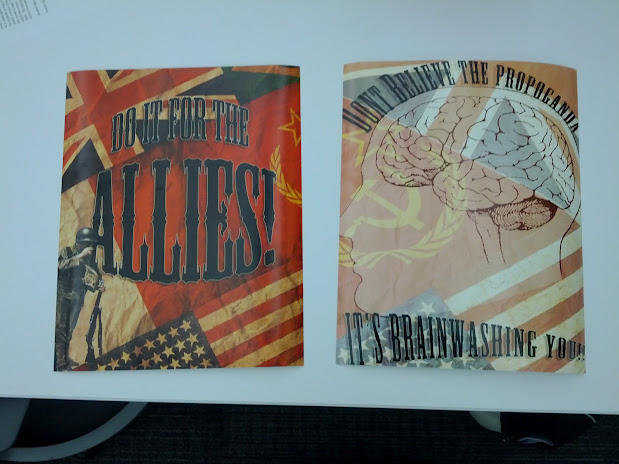
Student created WWII Propaganda Posters

The other thing I did as the year progressed is quit telling students what product to create but rather let them decide how they wanted to present it. I shared this list of different genres that students could choose from to present their projects. I had students write diaries, wear costumes, design their own propaganda posters, and even decorate a cake. Giving students choice in how they present is one of the most successful things I have found in PBL so far. As a bonus it is much more interesting than watching the same type of presentation over and over and over....


Next post will discuss we will discuss Knows/Need to Knows.

Thursday, April 26, 2012

Should I care if students like me?

I usually agree with Seth Godin but I think the tone of his post about Applause is wrong for education (I realize that he is talking about marketing). Particularly this quote:
 "Who decides if your work is good? When you are at your best, you do."

I think teachers often evaluate themselves too easily and blame students for their failures. I think students should have a say in evaluating teachers and how they teach. My concern is with teachers who dismiss all negative student comments and never consider if they are valid. These same teachers often assume that their teacher-centered methods are fine and that students need to adapt to them rather than vice-versa.

Too often I hear from educators comments such as "you can't please everyone" or it is not my job to "be a student's friend." Now while there is some truth to these axioms I am concerned about teachers who seem to ignore how students feel about them as a person. Some teachers even brag about students being disciplined or "put in their place."

So should teachers care if students "like" them? I think they should. Our first job as educators is to build relationships with students. How can students learn from or with us if they do not like us? Think back to your teachers (maybe way back for some of us). What do you remember? All of the content they taught you or how they made you feel? So I am concerned about teachers whose attitude is that is does not matter how students feel about them. This does not require us to be "best friends" or necessarily hang out socially with our students. But I do believe that teachers should get to know students personally. Students who enjoy you as a person are also more likely to enjoy your class.

So this week we had students fill out a long survey evaluating our school, the teachers, and our classes. I am the first to admit that I do not always accept criticism well (although ironically I really do want it). What came through on many of the anonymous surveys is that students do feel that I care about them and enjoy our class. I feel like I am doing a good job on my #1 goal for this year.

So I will go so far as to argue that making sure we have positive relationships with students is the most important and long-lasting part of our jobs. Will every student like us? Probably not, but we should try to build relationships with every student and impart love and confidence into their lives.

So Mr. Politician, #standardizethat